
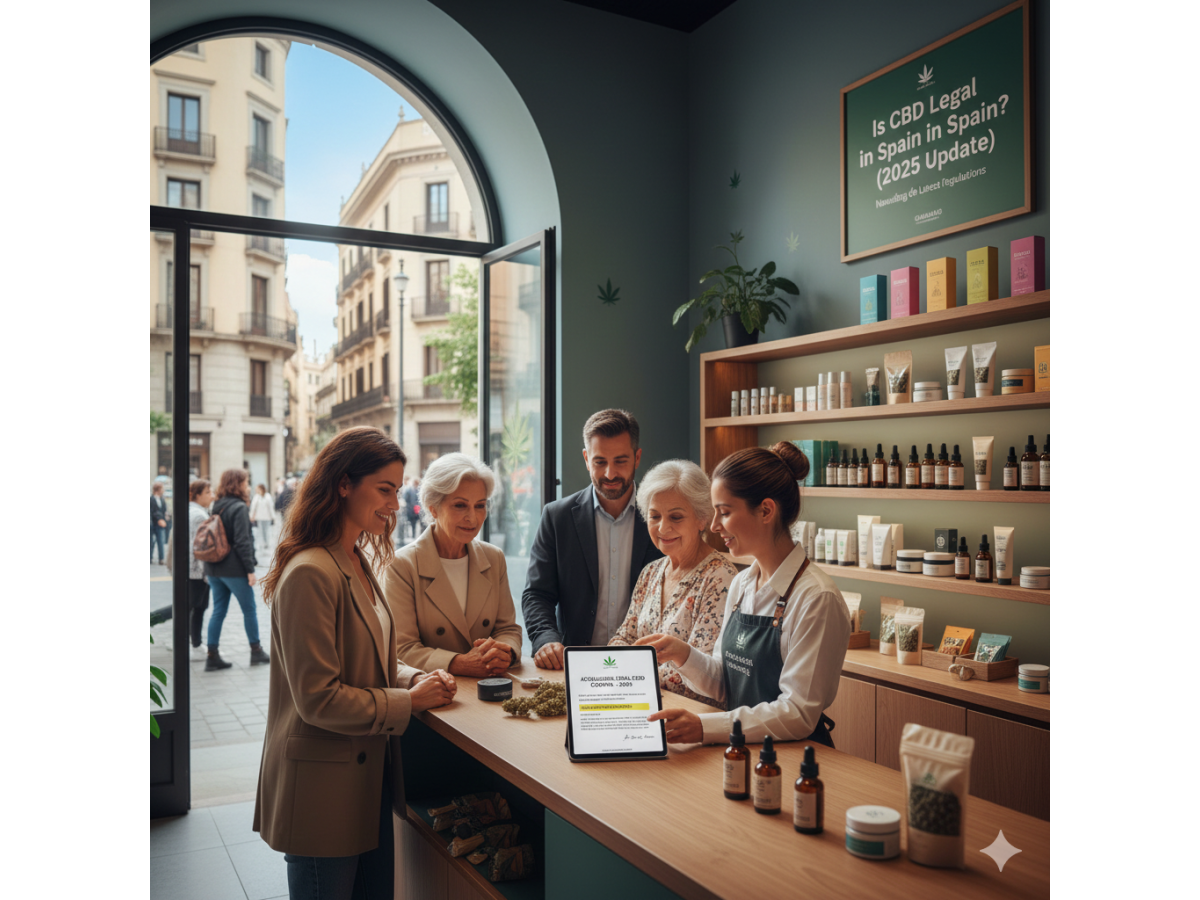
Short answer: CBD (cannabidiol) itself is not a controlled drug in Spain, but whether a CBD product is legal depends on what it is and how it’s marketed. Ingestible CBD (foods, gummies, drops for oral use) is not authorised as a food or food supplement. Cosmetics/topicals with CBD can be legal if they comply with EU cosmetics rules (e.g., CPNP notification, no medicinal claims, and effectively THC-free). CBD “flowers”/herbal material for smoking are generally not legal for consumption because cannabis flowering tops are treated as narcotics. Medical use of cannabis has a new, narrow hospital-only pathway under Royal Decree 903/2025 (AEMPS).[1][2][3][4]
Contents
- Legal snapshot (what’s allowed vs. restricted)
- What Spain & the EU authorities say (AESAN, EFSA, AEMPS, WHO)
- Detailed rules by product type
- Can I sell CBD for food use in Spain?
- Can you carry CBD in Spain?
- Market impact: opportunities & challenges
- FAQs (tests, grams, prices, travel)
- References
Legal snapshot (at a glance)
| Product category | Status in Spain (2025) | Key conditions / notes | Primary sources |
|---|---|---|---|
| CBD foods & food supplements (oils, gummies, beverages, drops for oral use) | Not authorised (Novel Food not cleared) | CBD is a novel food; EFSA paused evaluations due to safety data gaps; AESAN states cannabinoids (incl. CBD) cannot be used in foods in Spain unless authorised. | EFSA; AESAN Q&A 2025 |
| Hemp seeds & hemp seed oil (without added cannabinoids) | Allowed as traditional foods | Subject to EU maximum limits for THC equivalents: 3.0 mg/kg (seeds & most seed products) and 7.5 mg/kg (seed oil). | Reg. (EU) 2023/915; AESAN |
| CBD cosmetics/topicals (creams, balms, serums) | Allowed with conditions | Must comply with EU Cosmetics Reg. 1223/2009, be notified in CPNP, avoid medicinal/ingestion claims; authorities expect no detectable THC. The European Commission has asked its SCCS to set safe limits for CBD/THC traces. | AESAN; AEMPS – Cosmetics; EC/SCCS call |
| CBD “flowers” / herbal material for smoking | Not legal for consumption | Flowering tops (“sumidades floridas”) are classified as narcotics under the 1961 Convention; not permitted for food or consumer smoking without AEMPS authorisation. | AESAN; Coverage of enforcement |
| Medical cannabis (incl. CBD compositions) | Strictly controlled | New Royal Decree 903/2025: only specialist prescription in hospitals; prepared in authorised hospital pharmacies; AEMPS will publish monographs & manage a public register of standardised cannabis preparations. | BOE RD 903/2025; Ministry note |
| Hemp cultivation (industrial) | Allowed (with conditions) | Must use EU‑listed varieties ≤ 0.3% THC (agricultural field threshold) and meet national requirements; this is not a retail product THC limit. | EC Hemp page; Reg. (EU) 2021/2115 |
Note: The popular “≤0.2% THC means legal” claim is not accurate for most retail CBD in Spain. Legality turns on product category, EU/Spanish authorisations, and how the product is marketed and labelled.
What the authorities say
Spain (AESAN) on food use
Spain’s food-safety agency (AESAN) states clearly that cannabinoids not classified as psychotropics (including CBD) are novel foods and currently not authorised for use in foods in Spain. The mutual-recognition principle does not apply where no EU Member State legally markets such foods. AESAN also clarifies that flowering tops (cannabis “sumidades floridas”) are narcotics and excluded from the food definition. Seeds and leaves not attached to the tops from industrial hemp varieties can be used in food under strict conditions.[1]
EFSA (EU) on CBD safety as a novel food
The European Food Safety Authority (EFSA) put CBD novel food evaluations on hold (June 2022) due to data gaps (e.g., liver effects, endocrine and neurological endpoints, reproductive toxicity, drug–drug interactions). As of late 2025, EFSA has continued to conclude that submitted dossiers have not yet established safety.[2][11]
AEMPS (Spain) & medical-cannabis channel
Spain’s medicines agency (AEMPS) now operates a hospital-only pathway under Royal Decree 903/2025 for standardised cannabis preparations (with defined CBD/THC composition) prescribed by specialists and prepared in authorised hospital pharmacies. AEMPS will maintain a public register of these preparations and publish clinical monographs. This does not legalise consumer OTC ingestible CBD.[3][4]
WHO on abuse/dependence
The WHO’s Expert Committee on Drug Dependence concluded that pure CBD does not show abuse or dependence potential and recommended that preparations considered pure CBD should not be internationally scheduled—this is about pharmacology, not market authorisation for foods.[12]
Detailed rules by product type
1) Ingestibles (foods, food supplements, beverages, “oral drops”)
- Status: Not authorised as foods in Spain (novel food not cleared).[1][2]
- Enforcement trend: Coordinated inspections (2024–2025) found widespread non-compliance in shops/websites marketing ingestible cannabinoid products.[13]
- Hemp seeds & seed oil: Allowed as traditional foods, subject to EU maximum Δ9‑THC equivalents (3.0 mg/kg seeds & most seed products; 7.5 mg/kg seed oil).[5]
2) Cosmetics/topicals
- Status: Possible if fully compliant with Reg. (EC) 1223/2009 (safety report, responsible person, CPNP notification, GMP, labelling). National authorities (AEMPS/AESAN) emphasise no ingestion claims and compliance with narcotics rules (no THC contamination).[1][6]
- EU safety work ongoing: The European Commission has asked its SCCS to assess safe CBD concentrations and permissible trace THC levels in cosmetics (opinion pending).[7]
3) CBD “flowers” / biomass for smoking
- Status: Not legal for human consumption in Spain. Flowering tops are narcotics (“sumidades floridas”) under the 1961 Convention; retail sale for smoking has been subject to seizures/sanctions. Labelling as “collectible” does not remove narcotics or consumer-safety obligations.[1][8]
4) Medical cannabis (incl. CBD compositions)
- Pathway: Royal Decree 903/2025 enables hospital-only access to standardised cannabis preparations (with defined THC/CBD), prescribed by specialists when conventional treatments fail; prepared and dispensed by authorised hospital pharmacies; registry managed by AEMPS.[3][4]
5) Hemp cultivation (industrial)
- Threshold: EU CAP now recognises industrial hemp varieties ≤ 0.3% THC (field level) for CAP support; seed must be from the EU Common Catalogue. This is not a retail-product THC tolerance.[9][10]
Can I sell CBD for food use in Spain?
No, not at this time. Under EU law CBD is a novel food and EFSA has paused evaluations pending new safety data; Spain’s AESAN states cannabinoids (including CBD) are not authorised as foods/supplements. The recognition of mutual marketing does not apply where no Member State legally places the product on the market as food. Marketing non‑food items (e.g., aromatics) that imitate edible products or suggest ingestion also triggers consumer‑safety enforcement.[1][2]
Can you carry CBD in Spain?
- Topicals/cosmetics: Generally low risk if the product is a genuine cosmetic (external use only), in original packaging with compliant labelling, and effectively THC‑free.[1][6]
- Ingestibles (oils/gummies): Risky—not authorised as foods; products may be seized or flagged by authorities.[1]
- Flowers/herbal material: High risk—flowering tops are treated as narcotics for consumer use; possession/sale for consumption can lead to enforcement.[1][8]
Drug tests (DGT roadside): Spanish traffic controls analyse saliva for drugs like THC, cocaine, amphetamines, etc.—not CBD. However, full‑spectrum products or “CBD flowers” may contain enough THC to trigger a positive until confirmatory testing.[14]
Impact on the market: opportunities & challenges
- Opportunities: Cosmetics/topicals that meet EU cosmetics rules; traditional hemp foods (seeds, seed oil) within THC contaminant limits; R&D and medical access via the new hospital‑only framework.
- Challenges: No EU‑wide safety authorisation for ingestible CBD; strict labelling and claims control; enforcement against products that imitate foods or present ingestion; persistent confusion over “0.2% vs 0.3% THC.”
FAQs
Is CBD legal in Spain?
CBD as a substance is not scheduled. Legality depends on the product category: cosmetics (possible with conditions), foods/supplements (not authorised), flowers for smoking (not legal for consumption), and medical cannabis (hospital‑only under RD 903/2025).[1][2][3]
Can I carry CBD in Spain?
Carrying a compliant cosmetic (external use, no THC, no medicinal claims) is generally acceptable. Carrying CBD flowers or ingestibles marketed for consumption is risky and may result in seizure/enforcement.[1][8]
How many grams of CBD are “legal”?
There is no “grams” threshold. Compliance depends on product type, authorisation status, and composition (especially THC) — not on grams.[1]
Does CBD make you fail a drug test?
Roadside tests target THC, not CBD. However, full‑spectrum products or smoked “CBD” plant material can contain enough THC to yield a positive screening until laboratory confirmation.[14]
What about the 0.2% / 0.3% THC number I see online?
That percentage applies to field THC content of hemp varieties for agricultural purposes (now ≤0.3% under EU CAP). It is not a blanket retail-product limit allowing ingestible CBD in Spain.[9][10]
Compliance checklist (quick guide for businesses)
- Classify the product correctly: food/supplement (not authorised), cosmetic (possible), medical (AEMPS/hospital only), or other.
- Cosmetics: EU Reg. 1223/2009 compliance (PIF & CPSR), CPNP notification, GMP, labelling (no ingestion/medical claims), effectively THC‑free; ensure raw material sourcing consistent with narcotics rules; follow upcoming SCCS opinions.[6][7]
- Marketing: Do not suggest consumption for non‑authorised categories; avoid imitating edible products if not foods; follow AESAN consumer‑safety guidance.[1]
- Testing & documentation: Maintain Certificates of Analysis (CoAs) for cannabinoids and THC; verify THC is non‑detectable in cosmetics; demonstrate compliance with contaminant limits for hemp seed foods.[5]
References
- AESAN (Spain). Documento de preguntas y respuestas sobre el uso del cáñamo y cannabinoides en alimentación humana (12 May 2025). PDF: aesan.gob.es/.../CANNABINOIDES.pdf
- EFSA (EU). Cannabidiol novel food evaluations on hold pending new data (7 Jun 2022): efsa.europa.eu/.../cannabidiol-novel-food-evaluations-hold-pending-new-data | EFSA Journal statement: efsa.europa.eu/.../pub/7322
- BOE. Real Decreto 903/2025, de 7 de octubre (Cannabis medicinal hospitalario): boe.es/.../BOE-A-2025-20077
- Ministerio de Sanidad (Spain). Nota de prensa sobre el Real Decreto de cannabis medicinal: sanidad.gob.es/.../notasPrensa.do?id=6761
- European Commission. Regulation (EU) 2023/915 (THC maximum levels in hemp seed foods). PDF: eur-lex.europa.eu/.../32023R0915
- AEMPS (Spain). Cosmetics portal (framework & legislation overview): aemps.gob.es/cosmeticos/... and legislation
- European Commission / SCCS. Mandate to assess safe CBD levels and THC traces in cosmetics (Jan 2025): health.ec.europa.eu/.../sccs2022_q_036.pdf
- El País (reporting enforcement practice). “El cogollo, la nueva guerra policial...” (Dec 2022): elpais.com/.../el-cogollo-...
- European Commission – Agriculture. Hemp (0.3% THC threshold for varieties; Common Catalogue): agriculture.ec.europa.eu/.../hemp_en
- Regulation (EU) 2021/2115 (CAP). PDF: eur-lex.europa.eu/.../32021R2115
- EFSA (2025). Safety of synthetic cannabidiol as a Novel Food (opinion – safety not established): efsa.europa.eu/.../9708
- WHO ECDD (2018). Cannabidiol (CBD) Critical Review Report: who.int/.../whocbdreportmay2018-2.pdf
- AESAN (2025). Plan coordinado sobre cannabinoides en productos alimenticios (informe de resultados): aesan.gob.es/.../Plan_coordinado_cannabinoides.pdf
- DGT (Spain). Roadside drug controls (saliva test detects cannabis/THC): dgt.es/.../controles-alcohol-drogas/
Disclaimer: This article is for general informational purposes only and does not constitute legal advice. Always consult official sources or a qualified lawyer before making compliance decisions. Regulations and enforcement practices can change.
Write a comment