
Timeline: The Road to Regulation
Click on the milestones to view key details
Tradition and Counterculture
Birth of ARSEC & The "Corcuera Law"
Print Culture & Advocacy
The CSC Boom
The "Gag Law" & Catalan Law
The "Grey Zone" & Judicial Pressure
Spain has become, in the global imagination, a kind of “new Amsterdam”: a country where the private consumption of cannabis is decriminalized, cannabis social clubs (CSC) are multiplying, and cannabis culture fills the streets, magazines, and fairs such as Spannabis. All of this rests on a very specific geographical and political background: proximity to Morocco (the main source of the hashish consumed in Europe), a long tradition of hemp cultivation, and a legal framework that punishes trafficking but allows consumption and cultivation in private spaces.
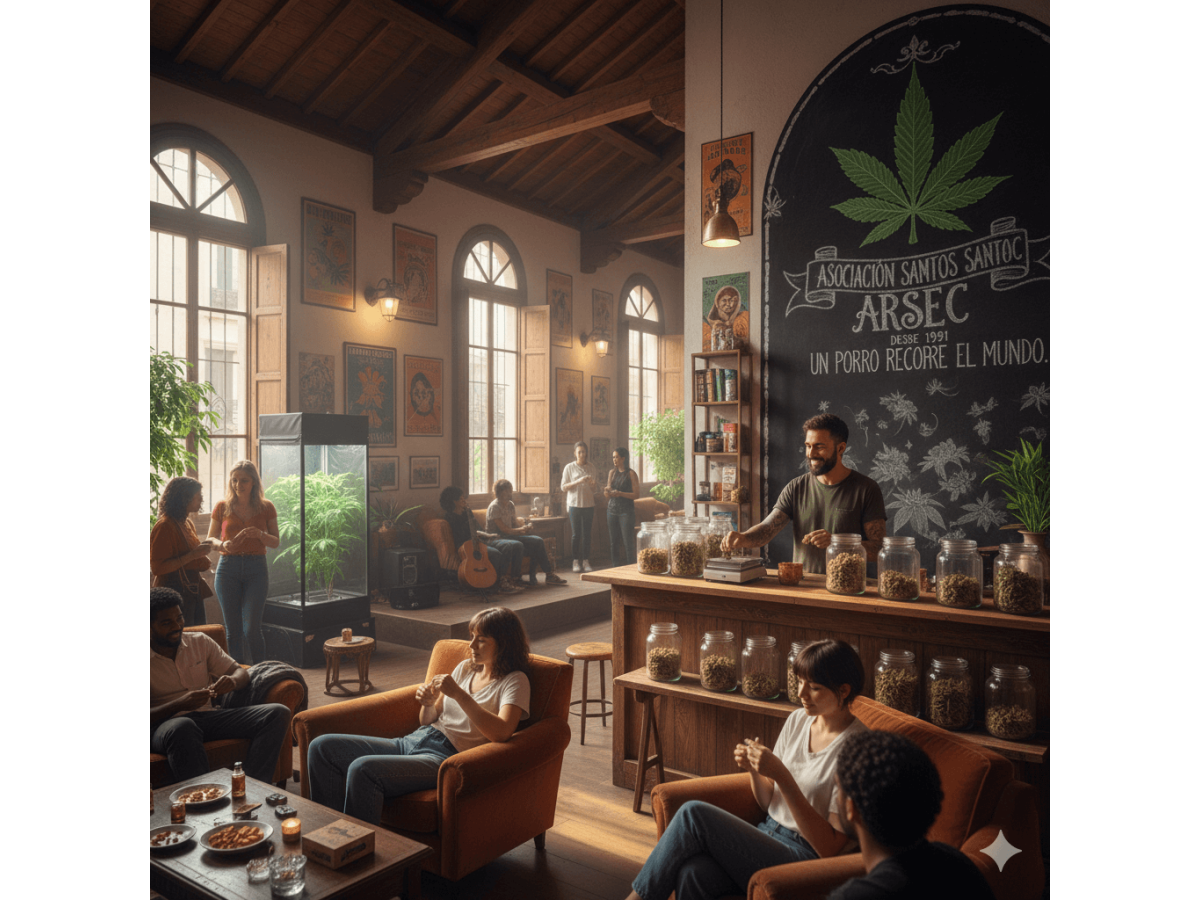
At the heart of this story is ARSEC (Ramón Santos Association for Studies on Cannabis), founded in Barcelona in 1991, regarded as the first cannabis association legally established in Spain and the origin of the model we now know as the Cannabis Social Club.
I. Spain and cannabis: basic concepts and why the country is associated with the plant
1. Why is Spain so strongly associated with cannabis?
Several factors explain the strong association between Spain and cannabis:
- Geography: the Strait of Gibraltar connects it directly with Morocco, one of the main producers of hashish in the world.
- Agricultural tradition: hemp has been cultivated on the Iberian Peninsula since ancient times, mainly for fiber and rope, and it has even left its mark in place names such as Cañamares or Santa Cruz de los Cáñamos.
- Particular legal framework: consumption and cultivation for personal use in the private sphere are not criminal offenses; what is punished is trafficking and consumption in public spaces.
- Club model: since the 1990s, associations of cannabis consumers have proliferated, a model that has drawn the attention of international bodies and has been emulated in countries such as Uruguay, Malta, and Germany itself.
All of this has led to Spain being described as a destination for “cannabis tourism,” with particular concentration in Barcelona and the Basque Country.
2. Key terms: CSCs, consumer associations, and Dutch coffee shops
In the Spanish context, several concepts are used that are worth distinguishing:
- Cannabis Social Club (CSC): term popularized by the Transnational Institute and European activism to refer to a non‑profit organization of users who come together to cultivate and distribute cannabis exclusively among their members, in a closed, private setting.
- Cannabis consumer association / cannabis association: a specific legal form in Spain: a non‑profit association, registered in the associations registry, whose purpose is the self‑supply and distribution of cannabis among its adult members, avoiding the illegal market.
- Differences from Dutch coffee shops:
- Coffee shops are businesses open to the public that sell cannabis to any adult (with certain limits), for profit.
- Spanish CSCs are private, closed associations, accessible only to members, non‑profit and, in theory, without sales to third parties or advertising.
The “Spanish model” has thus become an international reference point for those seeking non‑commercial ways of regulating cannabis.
II. From hemp fields to counterculture: historical background
1. Industrial hemp: a not‑very‑“subversive” plant
Long before anyone talked about joints, Spain was already a hemp country. Historical sources document intensive cultivation of industrial hemp for sails, ropes, fabrics, paper, and oils since the Middle Ages, with important centers in Valencia, Catalonia, and Castilla‑La Mancha.
In the period of al‑Andalus, extensive use of cannabis is documented both for fiber and for food and medicinal purposes, under names such as “sedenegi” – “king of seeds” – and the use of cannabis pipes at sites such as Medina Azahara, centuries before the introduction of tobacco in Europe.
2. From the 60s to the 80s: hash, hippies, and the first circles of consumption
In the second half of the 20th century, the story takes a turn. With the cultural opening of the 1960s–70s, contact with European and North American hippie scenes, and the proximity to Morocco, Moroccan hashish becomes the main form of cannabis consumed in Spain.
In this period, there appear:
- Small informal circles of consumption in flats, alternative neighborhoods, and student environments.
- The first activist figures, such as Fernanda de la Figuera, known as the “Marijuana Grandma,” who begins to cultivate and advocate for the legalization of cannabis from the 1970s onward and would later become one of the visible faces of the movement.
3. From criminal repression to administrative fines
At the same time, drug policy shifts from a basically criminal approach to a mixed criminal–administrative model:
- Drug consumption ceases to be a criminal offense, but the offense of trafficking and promoting consumption is maintained (today, Article 368 of the Criminal Code, with prison sentences of 1 to 6 years depending on the substance).
- Organic Law 1/1992 (known as the Corcuera Law) introduces fines for consumption or possession in public streets; in 2015 these sanctions are reinforced by Organic Law 4/2015 on Citizen Security (the “Gag Law”), which provides for fines of €601 to €30,000 for consumption or possession of drugs in public places.
- Consumption and cultivation for personal use in private places remain outside the scope of criminal law, which opens the door, years later, to the idea of collective consumption in private contexts (the future theory of shared consumption and CSCs). :contentReference[oaicite:16]{index=16}
Even today, the debate over what constitutes “public space” continues: in 2025 the Ministry of the Interior sent instructions to law‑enforcement agencies so that drug consumption inside parked vehicles is not sanctioned, considering them spaces of protected privacy, as long as there are no indications of trafficking.
III. The birth of cannabis associationalism and ARSEC
1. Early 90s: crisis of prohibitionism and search for alternatives
In the late 1980s and early 1990s, several factors drive a change of approach:
- The evident failure of the “war on drugs”, with illegal markets expanding.
- The impact of HIV/AIDS and other health crises, which lead to the adoption of harm‑reduction strategies.
- The emergence of new social movements that demand the rights of drug users and criticize prohibitionism, something analyzed in depth in studies such as Isidro Marín Gutiérrez’s thesis on cannabis culture in Spain (1991–2007).
In this context, the idea emerges that, if private consumption is not a crime, perhaps consumers can self‑organize collectively to supply themselves without resorting to the black market.
2. ARSEC: the first legal cannabis association (Barcelona, 1991)
In 1991, the Ramón Santos Association for Studies on Cannabis (ARSEC) is founded in Barcelona, considered the first cannabis association formally registered in Spain.
According to the available documentation:
- ARSEC was founded by a group of activists that included Jaume Torrent, Damiá Carulla, César and Sergi Doll, Pep Terrones, José Baltiérrez, and Felipe Borrallo.
- Before taking the step, they consulted the Anti‑Drug Prosecutor’s Office of Catalonia about the legality of a collective crop for self‑consumption. The answer at that time was favorable, as long as it was for personal use and non‑profit.
- On the basis of that interpretation, they registered the association in the Generalitat’s registry and organized a self‑supply system for their members.
The association’s name pays tribute to Barcelona lawyer Ramón Santos, who had died a few years earlier and devoted his career to defending consumers of illegal substances and providing legal advice to part of the founding core.
3. The “first collective crop” and the “Catalan breach”
ARSEC moved from theory to practice when it organized a collective crop in the Camp de Tarragona to supply around a hundred members.
The scheme was simple, at least on paper:
- A closed group of adult members, previously identified.
- An estimate of each member’s annual consumption.
- A single crop whose product was shared among them, with no sales to third parties.
The plantation was discovered, those responsible were charged, and the case ended up in the courts. In the first instance, the court acquitted the members of ARSEC, understanding that there was no trafficking but shared self‑consumption. However, the prosecution appealed and the Supreme Court ended up convicting them with a minor prison sentence and a fine, based on the idea of an “abstract danger” to public health.
Paradoxically, that conviction helped to:
- Bring visibility to the debate on the possibility of organizing consumption collectively.
- Shape the doctrine of shared consumption in private, closed spaces.
- Inspire other initiatives that would eventually crystallize into the Cannabis Social Club model.
4. From experiment to reference: ARSEC as the seed of a movement
The impact of ARSEC went far beyond its own court case:
- In a few years it went from a handful of founders to thousands of members (around 3,000 in 2001 and about 5,000 in 2004).
- In 1997, members of the association launched the magazine Cáñamo, today the best‑known cannabis publication in Spanish, with the aim of “normalizing and disseminating” information about the plant.
- ARSEC also published a cultivation manual for self‑consumption, which became a bestseller and helped spread the culture of home growing.
In a commemorative text, Cáñamo sums up ARSEC’s role with a phrase that has become famous: “A joint is sweeping the world”, to describe how that small group of pioneers opened a legal and symbolic breach that inspired clubs and activists around the globe.
IV. From association to model: formation of Cannabis Social Clubs
1. Basic principles of the CSC model in Spain
Drawing on the experiences of ARSEC and other associations, a series of principles that define the Cannabis Social Club model are consolidated, as described by TNI, the Civil Observatory on Drug Policies, and the federation of associations itself:
- Non‑profit nature: CSCs are non‑profit associations. Members’ contributions are intended to cover cultivation, premises, and staff costs, not to generate distributable profits.
- Closed and with limited membership: access is limited to adults, identified, usually already consumers, and endorsed by another member. There is no access for the general public nor “over‑the‑counter” sales.
- Collective self‑supply: only the amount needed to cover the expected consumption of the members is cultivated (or acquired), avoiding surpluses that could be interpreted as trafficking.
- Controlled distribution: cannabis is handed out at the association’s premises, in measured and recorded quantities; in many cases, taking product out onto the street is discouraged to reduce legal risks.
- Health and harm‑reduction focus: many clubs provide information on potency, composition, and risks, and offer guidelines for responsible use; some collaborate with programs for substance analysis and psychosocial care.
- Self‑regulation: most federations have drawn up codes of good practice on production limits, accounting transparency, protocols against abuse, etc.
2. From ARSEC to the first wave of CSCs in Barcelona and Euskadi
After ARSEC, the model is replicated and adapted in other regions:
- In the Basque Country, associations such as Pannagh and others emerge, combining collective crops with a strong dimension of political activism and strategic litigation.
- In Barcelona, the idea of a private social club spreads rapidly in the late 1990s and early 2000s, and the city gradually consolidates itself as the “European capital” of CSCs.
The Transnational Institute describes how, since 2002, CSCs have allowed thousands of people to stop financing the illegal market, to know what they are consuming, and to participate in a horizontal, community‑based model of access to cannabis.
3. FAC, regional federations, and ConFAC
As the number of associations grows (around 1,000–1,200 clubs in 2014 according to estimates compiled by Cáñamo), the need arises to coordinate and speak with a single voice before the authorities and the media.
Hence the creation of:
- FAC (Federation of Cannabis Associations), as a nationwide structure for coordinating clubs and associations.
- Regional federations such as CatFAC in Catalonia or EUSFAC in Euskadi, which group together dozens of CSCs and work on good practices, risk reduction, and political dialogue.
- ConFAC (Confederation of Federations of Cannabis Associations), which brings together the federations and coordinates campaigns such as the World Marijuana March, parliamentary hearings, and collective responses to legal changes.
This structure of federations and confederations reinforces the character of an organized social movement, going beyond the mere existence of local “clubs.”
V. The legal “grey area” and political experiments
1. General legal framework: between personal use and trafficking
The legal fit of CSCs is built in a grey area between:
- The principle that consumption and possession for personal use in the private sphere are not criminal offenses, even when dealing with scheduled substances.
- Article 368 of the Criminal Code, which punishes the cultivation, production, trafficking, or any form of facilitation of the illegal consumption of drugs, with prison sentences of 1 to 6 years in the case of cannabis.
- The doctrine of shared consumption and the “strictly private sphere”, developed by the Supreme Court to exclude from the crime certain cases of group consumption (limited quantity, a small and previously determined group, non‑profit). :contentReference[oaicite:42]{index=42}
Researchers such as Amber Marks have described CSCs as a “zone of privacy” protected by fundamental rights, but one that is under constant tension with criminal law and international drug‑control conventions. :contentReference[oaicite:43]{index=43}
2. Local and regional experiments
In the absence of state‑level regulation, several autonomous communities and city councils have attempted to regulate the clubs within their own areas of competence:
- Basque Country: the Basque Parliament opened a debate process on a specific CSC law, drawing on academic reports that suggested the clubs would be legal if they remained closed, non‑profit, and limited quantities to normal consumption by their members.
- Barcelona City Council: approved a special urban‑planning scheme to regulate the location of clubs and limit their concentration in certain neighborhoods, attempting to reconcile public health, coexistence, and the reality of the movement.
- Other municipalities: cases such as Rasquera, which tried to lease municipal land for a collective crop linked to an association, showed both the potential and the limits of these experiments, which are usually halted by the courts or the central government. :contentReference[oaicite:46]{index=46}
3. Law 13/2017 on cannabis consumer associations in Catalonia
The most ambitious attempt at regulation came from Catalonia. After a Popular Legislative Initiative (ILP) called “La Rosa Verda”, promoted by CatFAC, other federations, and the Civil Observatory on Drug Policies, the Parliament passed in 2017 Law 13/2017 on cannabis consumer associations.
The law:
- Recognized cannabis consumer associations as non‑profit associations, required to register in a specific registry.
- Defined as objectives self‑supply for private consumption and the reduction of risks associated with the clandestine market and certain uses of cannabis.
- Established criteria for democratic organization, transparency, quantity control, and operating rules (assemblies, management reports, etc.).
However, in 2018 the Constitutional Court annulled the law for invading state powers in criminal matters, declaring its central aspects unconstitutional.
Even so:
- Some of the licenses and municipal ordinances issued in the wake of the law have continued to operate de facto, although with a weaker legal basis.
- The experience of La Rosa Verda is cited today as an example of citizen mobilization capable of bringing the issue onto the legislative agenda.
4. Supreme Court rulings and a changing judicial climate
In the 2000s, several Supreme Court rulings seemed to accept that certain forms of collective cultivation and shared consumption could fall outside the criminal offense, which fueled the boom in CSCs.
But from the 2010s onward, the wind changes:
- The Supreme Court begins to consider that large associations with hundreds or thousands of members “promote or facilitate” illegal consumption, going beyond the framework of tolerated shared consumption.
- Convictions of club boards of directors multiply, sometimes with sentences of several years in prison, generating a strong deterrent effect and a climate of legal uncertainty. :contentReference[oaicite:55]{index=55}
In short: the CSC model survives, but always under the threat of a more or less benevolent judicial interpretation.
VI. Cannabis culture: media, industry, and the street
1. Magazines, humor, and language: building a culture of its own
The social normalization of cannabis in Spain cannot be understood without its specialized media:
- Cáñamo, founded in 1997 by ARSEC members, combines reports, humor, interviews, and cannabis history and politics, and has become the main Spanish‑language reference point.
- Cannabis Magazine and other publications feature the “chronology of the cannabis movement in Spain”, legal analyses, and accounts of activism.
- Blogs and portals such as Alchimia disseminate cannabis history, sector news, and educational content on cultivation and policy.
These media have contributed to:
- Creating a shared language (from “porro” to “maría,” via “social club,” “grow,” “green tide”…).
- Spreading a distinct aesthetic and humor, mixing political satire with pop culture and counterculture.
- Turning consumers into a political subject and not just “patients” or “criminals,” by giving them a voice in interviews, columns, and manifestos.
2. Grow shops, seed banks, and the cannabis industry
Since the 1990s, the first grow shops and seed banks have appeared, bringing to Spain indoor cultivation techniques, Dutch genetics, and a wide range of products (lighting, fertilizers, substrates, etc.).
Over time, Spain becomes:
- A key market for the seed industry, with local and international banks based in the country.
- An ecosystem where clubs, grow shops, and seed banks coexist: the clubs cannot sell cultivation material, but they share clientele and culture with specialized shops.
In addition, large fairs such as Spannabis consolidate this industry and reinforce Spain’s image as the European epicenter of cannabis culture.
3. Marches, festivals, and 4/20
The Spanish cannabis movement also expresses itself in the streets:
- Since the 1990s, demonstrations for the legalization of cannabis have been held in cities such as Madrid, Barcelona, or Bilbao, linked to the global Million Marijuana March.
- The World Marijuana March (MMM), coordinated in Spain by ConFAC, brings together thousands of people every year, with manifestos calling for comprehensive regulation and an end to criminalization.
- Leisure events, 4/20 days, festivals, and activist gatherings make up an annual agenda that mixes celebration, protest, and harm‑reduction education.
4. Gender and activism: from the “Marijuana Grandma” to feminist networks
The Spanish cannabis movement also has a distinctly female face:
- Fernanda de la Figuera, the aforementioned “Marijuana Grandma,” was the country’s first “legal” grower thanks to a 1995 ruling that recognized her crop for self‑consumption; she founded associations and remained on the front line until her death in 2022.
- Groups such as the State Network of Anti‑Prohibitionist Women (REMA), the Cannabis Women’s Gatherings, and many local collectives have put the gender dimensions of drug policy on the table: gender‑based violence, caregiving, stigma, and differential penalization.
- Projects such as the documentary “Cannábicas” collect testimonies from women users and activists from more than 30 countries, making visible a transnational feminist cannabis movement in which Spanish women occupy a central place.
This feminist approach reinforces the idea that the struggle for cannabis regulation is not only a matter of consumption, but also of rights, care, and social justice.
VII. Present and future (the 2020s): between social laboratory and political deadlock
1. How many CSCs are there and where are they?
Exact figures are elusive, but several sources agree that:
- In 2014 there were an estimated 1,000 to 1,200 cannabis associations in Spain.
- Online guides and maps from 2025 list around 200–300 active clubs (those they know of and have verified), with a heavy concentration in Catalonia and the Basque Country, but also with a presence in Madrid, the Valencian Community, the Balearic Islands, and the Canary Islands.
In geographical terms:
- Barcelona consolidates itself as the city with the most CSCs, to the point of being described as the “European cannabis capital”, which creates tensions with municipal policy and with sectors concerned about cannabis tourism.
- In the Basque Country, the clubs maintain a strong tradition of associationism and institutional dialogue.
- In the Canary Islands, especially Tenerife and Gran Canaria, a very lively associative scene is mixed with recurrent police operations against certain CSCs, which illustrates the fragility of the model.
2. Medical users and the “social” function of the clubs
Although Spain does not (yet) have a generalized system of medical cannabis dispensaries, numerous studies and reports show that many CSCs function de facto as an informal support network for patients with chronic pain, epilepsy, cancer, or other conditions for which cannabis can relieve symptoms.
In this sense:
- CSCs offer a product of known origin, a supportive community, and sometimes basic advice.
- For certain patients, especially those excluded from official treatments with nabiximols (Sativex) or pharmaceutical cannabidiol, the club is perceived as the safest option compared with the clandestine market.
3. New wave of controls and repression
In recent years, the CSC model has been going through a particularly tense phase:
- The International Narcotics Control Board (INCB) has criticized the proliferation of clubs in Spain, pressuring the state to rein them in.
- In Barcelona, the current municipal government has announced plans to close or drastically limit CSCs, drawing on court rulings that question their legal fit and on public‑order and health arguments. Various media report stricter ordinances and the closure of dozens of clubs in 2023–2024.
- In the Canary Islands, police operations against CSCs in Tenerife have caused alarm among members and activists due to the severity of some actions.
- At the state level, some interpretations of Article 368 of the Criminal Code regarding club boards have been toughened, although there are still rulings that reduce sentences by recognizing social changes around cannabis.
In parallel, attempts to pass a state cannabis law (whether medical or comprehensive) have run up against divisions between governing and opposition parties, even though organizations such as ConFAC, ICEERS, or the Civil Observatory have presented detailed regulatory proposals.
4. International comparison: Uruguay, Canada, Germany, Malta… and Spain?
While Spain remains in a kind of regulatory limbo, other countries have made clearer decisions:
- Uruguay (2013) legalizes recreational cannabis and establishes three access routes: home growing, regulated CSCs, and sales in pharmacies.
- Canada (2018) passes the Cannabis Act, which legalizes and regulates the production and sale of cannabis at the federal level, with licensing systems and quality control.
- Germany (2024) adopts the Cannabisgesetz, which allows home growing, limited possession, and the creation of non‑profit cultivation associations (a model very close to CSCs) as of July 2024.
- Malta (2021) creates a system of non‑profit cannabis associations under state license, managed by a specific authority (ARUC).
The irony is that the Spanish CSC model explicitly inspired several of these countries, but within Spain it continues to rely on a fragile combination of associational practice, administrative practice, and shifting case law, without a state law to enshrine it.
VIII. Conclusion: Spain as a laboratory of self‑organization and the legacy of ARSEC
In perspective, Spain can be seen as a laboratory of consumer self‑organization in the face of a rigid prohibitionist framework:
- From the medieval hemp fields to the cannabis social clubs of the 21st century, the country’s relationship with the plant has gone through phases of full integration, medicalization, criminalization, and now “organized a‑legality”.
- ARSEC symbolizes the moment when a small group of people decide to push the letter of the law to its limits to show that another approach is possible: collective self‑consumption, transparency, users’ rights, and criticism of the clandestine market.
- From that pioneering association came magazines, manuals, discourse, litigation and, above all, an idea: that consumers can organize themselves as a political and community subject, not just as the object of police intervention.
The result today is a mature movement, with federations, codes of good practice, feminist networks, observatories, researchers, and thousands of people organized in clubs… but on a fragmented and unstable legal terrain, subject to judicial swings and often contradictory political decisions.
From the perspective of global drug policy, the Spanish experience shows that:
- Civil society can anticipate the law, generating bottom‑up regulatory models that other countries then incorporate into their legislation.
- Without a clear regulatory framework, even the most advanced models can become trapped in a “grey area” that wears down activists and users and preserves some of the problems they were meant to solve (legal uncertainty, clandestine market, stigma).
What will happen in the next decade – whether Spain opts for regulated legalization, for formally recognizing and regulating CSCs, or for retreating into a more repressive approach – is unwritten. What is clear is that the name ARSEC and the idea of the Cannabis Social Club are already part of the world history of cannabis, regardless of what the official gazettes say.
Important final note: this text has a historical and analytical purpose; it is not legal advice nor an invitation to break the law. Cannabis consumption carries health risks and its legal situation is complex; any specific decision should be made with up‑to‑date information, professional support, and within the legal framework in force in each territory.
Write a comment